
A Founder Letter on Bkper’s Next Act
I have been thinking about this moment for a long time.
On the surface, the Bkper Partner Program is simple: people who help others adopt Bkper should be able to earn recurring revenue from that work. If you introduce a customer, you should participate in the value created over time. If you mentor another partner and help them grow, you should also participate in that success.
But for me, this is much more than a partner program. It is a checkpoint on our journey — a way to say where we came from, what we believe, why accountants matter more than ever, and how I see the next acts of Bkper unfolding.
Why we built slowly
When we started Bkper, I was convinced that finance and accounting should not be a maze of rigid modules, manual exports, monthly batch routines, and human workarounds.
The first pitch, back in 2010, was simple: use natural language processing and machine learning to turn a single line of text into a bookkeeping transaction.
This was long before today’s AI wave, but the direction was already there. The interface to accounting could become much simpler, and the system behind it had to be structured enough to turn human language into reliable financial records.
A Book should be a source of truth. A transaction should be an explicit movement of resources from one Account to another. Balances should come from the ledger, not from copied numbers. Every action should leave an Event. Automation should react to the flow of the business, not force the business into the shape of a legacy system.
That also shaped the business model. Charging per user never made sense to us. Bkper was meant to be collaborative: owners, teams, accountants, bookkeepers, advisors, clients, developers, and automations working around the same source of truth. A per-seat model would punish collaboration.
The hard part was finding the right abstraction and unit of value. For Bkper, that unit became the transaction: a business event captured in the source of truth, creating value through reporting, automation, collaboration, auditability, and AI context, while also reflecting the platform work required to preserve it.
This first act took a long time — close to fifteen years, depending on where you start counting.
Not because we wanted to move slowly. I have never wanted Bkper to move slowly. But primitives are expensive. A sustainable model is expensive. Trust is expensive.
It is easy to build a feature that looks good in a demo. It is much harder to build a financial system that keeps working across countries, currencies, business models, workflows, integrations, auditors, accountants, developers, and AI assistants.
We had to do the hard, foundational work before building the economic layer around it.
Act I: build the model, tools, and primitives
The first act of Bkper was about making the ledger programmable and understandable.
I was never interested in replacing accounting fundamentals. The fundamentals are powerful because they preserve truth. What I wanted to replace was the unnecessary complexity around them.
Traditional systems often force people to think in terms of screens, modules, closing routines, exports, imports, and vendor-specific workflows. Bkper starts from a simpler abstraction:
Something moved from here to there.
That from-to model is intuitive to a business owner, precise enough for an accountant, and structured enough for a developer or AI agent.
Around that model, we built the primitives: Books that stay balanced, Accounts that can represent anything countable, Transactions as resource movements, Groups for reporting perspectives, properties and hashtags for context, Events for trust, and Bots, Apps, APIs, Sheets integrations, agents, and developer tools on top.
This is why we care so much about simplicity. Simplicity is not a lack of ambition. It is how ambition becomes durable: if people can learn the model, they can trust it; if they can trust it, they can build on it.
That is the foundation we needed before the next act.
The accountant’s role is changing
AI is now compressing large parts of the accounting workflow: data entry, document extraction, categorization, first-pass reconciliation, draft reports, tax worksheets, anomaly detection. Much of this work will become faster, cheaper, and sometimes nearly invisible.
That can sound threatening if accounting is defined as manual production. But I do not believe the accountant disappears. I believe the accountant becomes more important.
The role changes from doing every mechanical step to designing, validating, and governing the system that produces financial truth.
The accountant of the next decade becomes a model designer, reviewer, controller, translator, workflow architect, and trusted advisor — helping businesses represent reality correctly, decide what is ready to become final, define where automation is allowed, connect local regulation with operational data, and understand what the numbers mean.
This is why source-of-truth infrastructure matters.
AI can draft. AI can summarize. AI can suggest. AI can route. But in finance, raw AI output cannot be the final word. Numbers need deterministic paths. Records need audit trails. Assumptions need to be visible. Professionals need to review what matters.
In that world, accountants and bookkeepers are not pushed to the side. Their role moves upstream: helping businesses operate with confidence where software can do more work, faster, but where trust still has to be earned.
Act II: build sustainable economics for the people creating trust
The Partner Program is our second act.
It is not just an affiliate program. It is an economic statement.
Software companies already share revenue with infrastructure providers: cloud platforms, payment processors, data providers, AI model providers, and compliance services. Those providers are important. We use them too.
But the people who create adoption, understanding, implementation, and trust often receive the least aligned economics. That does not make sense to me.
A customer rarely adopts a financial system because of a landing page alone. They adopt it because someone helps them make sense of their books, configure their workflow, understand their reports, integrate their tools, clean up their data, or trust the process.
I do not see these professionals as a distribution channel. I see them as people who create trust around Bkper — helping customers turn a ledger into a working financial system.
Bkper is no longer just an idea. It is a real business that supports our team and our families, and it is deeply embedded in the daily work of customers whose own teams depend on it. Value already flows through that ecosystem. Partners are the missing participants.
The subscription value stack is changing
For years, 80% gross margin became almost a badge of honor in SaaS. The ideal was to build software once, distribute it globally, and keep most of the economic value at the center.
I think the traditional 80% margin SaaS model is dead as the north star for AI-era financial infrastructure.
Not because software should become unprofitable. Bkper must be profitable. But AI-era financial infrastructure has a different value stack. Inference is not free. Compliance is not free. Trust is not free. Distribution is not only a landing page. And the people who help customers adopt, configure, review, and trust the system are part of the value creation, not an afterthought.
When I think about the economics around a subscription, I do not see a simple software margin line. I see several recurring claims on the value created:
- Rails and public obligations — Stripe and card networks, VAT/GST or sales tax, withholding, income or gross-receipts taxes, Delaware and California obligations, employer taxes, compliance, and the cost of operating across jurisdictions.
- Infrastructure and intelligence — Google, Cloudflare, AI providers, storage, compute, security, observability, data processing, and the systems that keep Bkper reliable.
- Partners and ecosystem — accountants, bookkeepers, advisors, educators, mentors, developers, and implementation partners who create adoption, understanding, workflow design, review, and trust.
- Bkper margin and reinvestment — the team, support, product development, reserves, profit, and the long-term durability of the company.
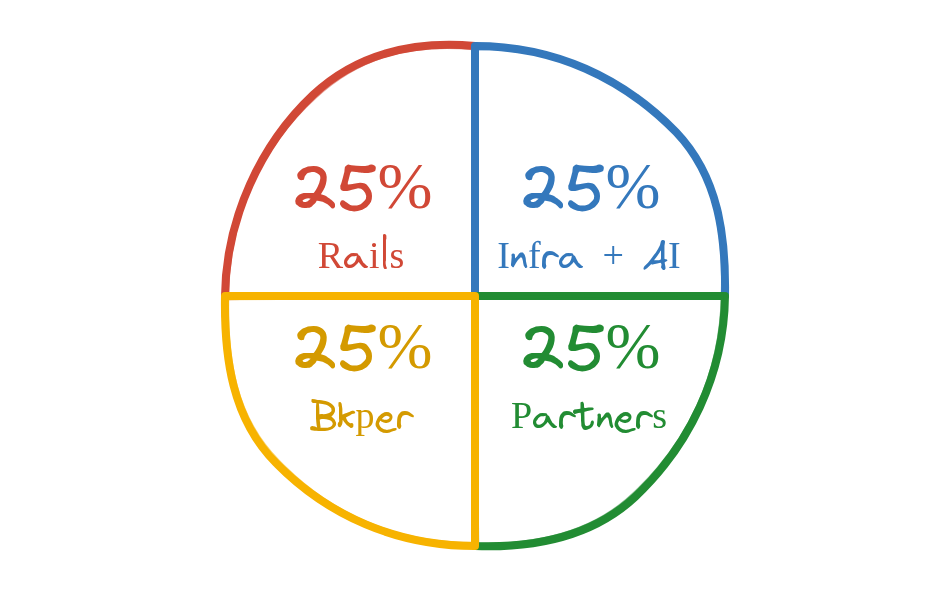
The exact percentages will change by country, plan, payment method, customer profile, tax treatment, and stage of the company. Some costs apply to gross payments; others to net revenue, payroll, profits, or the reality of operating globally.
But the principle matters.
The next generation of software should not be built only around maximizing the margin captured at the center. It should help more people generate value, prove that value, and participate in the recurring economics that follow.
I do not believe universal income is the core answer. I believe in universal value generation: more people creating measurable value, with systems that make participation possible.
This only works if Bkper stays intentionally lean. A partner share is not magic; it comes from choosing not to absorb all available margin into headcount, process, and internal complexity. I would rather build a small, highly leveraged company around strong primitives, AI-assisted workflows, and partners who create value at the edge than a large organization that has to keep more economics at the center to support its own weight.
The same should be possible for partners. AI should not only make large firms more efficient. It should let small accounting teams, solo advisors, educators, and consultants build repeatable systems, serve more clients with higher consistency, and turn judgment into scalable assets without needing a large staff.
So the Partner Program starts from a simple idea:
If you help someone build better books on Bkper, you should be able to participate in the recurring value that follows.
That is why we are designing it around recurring revenue, not one-time bounties. Trust compounds: a good implementation can keep creating value for years, and a good advisor can help a client grow from a simple Book to a sophisticated finance operation.
Education compounds too. Helping accountants, CPAs, bookkeepers, advisors, and community leaders understand AI, automation, source-of-truth ledgers, and Bkper’s model is real work. The mentor layer recognizes that: a partner who helps another professional become effective with Bkper can participate when that professional later brings paying customers.
Our initial model is intentionally simple: a direct partner earns from customers they bring, and a mentor can earn a smaller bonus when partners they introduced grow with their own customers. No infinite layers. No complex tiers. No hidden customer markup.
The point is alignment, not extraction. I want partners to build durable revenue with Bkper because durable partner businesses make the whole ecosystem stronger.
Before opening this broadly, we will live with the program ourselves so unclear attribution, confusing payout rules, or wrong incentives become visible internally before partners build on it.
Sustainable partner revenue requires sustainable infrastructure
There is another side to Act II: if we want to share more value with partners, we also need to keep the cost structure of the platform sustainable.
AI makes this urgent because it changes both sides of the equation. Partners can use AI to lower the cost of service delivery — less manual entry, cleanup, and repetitive configuration. At the same time, Bkper has to make inference affordable enough to be part of the subscription, not an expensive add-on or a dependency on one or two centralized providers.
The next generation of finance products will depend heavily on inference: parsing documents, understanding context, suggesting classifications, generating explanations, detecting anomalies, and helping users interact with their books in natural language.
If all of that depends on a small number of centralized AI providers, the ecosystem inherits high costs, provider dependency, regulatory exposure, and less control over latency, availability, and model behavior.
The goal is not to avoid AI. The goal is resilience: the right model for the right task, everyday AI workflows that remain affordable, and less dependency on any single provider.
This matters for partners too. When AI reduces the cost of delivery and the platform reduces the cost of inference, the Partner Program can turn part of that efficiency into recurring revenue for the people creating trust.
That is the Act II thesis:
Build the economic and infrastructure layer that lets partners earn recurring revenue while the platform becomes more resilient, less dependent, and more affordable to operate.
This is not about replacing service firms
I do not see Bkper as a replacement for accountants, bookkeepers, or advisory firms. I see Bkper as a platform for them to build on.
A good accountant should not spend their best hours moving data between systems. A bookkeeper should not be trapped redoing the same cleanup work every month. A consultant should not rebuild the same reporting pipeline from scratch for every client.
The platform should carry more of the mechanical load. The professional should carry more of the judgment.
Partners can build repeatable systems, reusable templates, automations, workflows, and review processes. They can serve more clients with higher consistency, turn expertise into assets, and earn recurring revenue from the infrastructure they help clients adopt.
This is how accounting becomes more accessible without making the profession less valuable.
Act III: broaden participation
There is a third act I can see ahead, even if it is not for today: Bkper should become a company that more people can participate in — not only as users or partners, but potentially, one day, as public participants in the company itself.
That could mean going public, if and when the company, market, regulations, and responsibilities make it the right path. It could also mean other structures that allow broader participation while preserving the mission. I am not making a promise or setting a timeline here.
But the direction matters. I do not want Bkper to become a closed financial infrastructure company where value concentrates only at the center. I want a path where the people who use, trust, extend, teach, and grow the system can participate more deeply over time.
The first step is product trust. The second step is partner economics. The third step is broader ownership and participation, when we can do it responsibly.
I am especially grateful to the customers who pushed Bkper far beyond what we could have imagined internally. They tested the model, challenged the product, found the edges, and helped us understand what Bkper needed to become. We would not be here without them.
The invitation
The Partner Program is our invitation to build that next era together.
The next era of accounting will need automation and judgment, AI and human trust, better infrastructure and better professional economics for the people who help businesses use that infrastructure well.
Financial truth must remain grounded in deterministic, auditable systems. And the people who create adoption and trust should participate in the recurring value they help create.
If you help clients structure books, automate workflows, reconcile operations, prepare reports, review tax facts, or understand financial reality, I want Bkper to become a platform you can build a business around.
If this resonates with you, learn more about Bkper Partners.
This is still early. We will keep the first version simple, listen carefully, and improve it with the people who use it. That is how Bkper has always grown: not by adding complexity for its own sake, but by finding the simple primitives that make the next layer possible.
I am grateful to everyone who helped us get here.
And we are just getting started.