

Events
Understand how Events form the audit trail of every action in your Book — and how they power automations, bots, and AI agents.
Every action in a Book generates an Event: posting a transaction, editing an Account, attaching a file, changing permissions, or running an automation.
Events record:
- who or what acted — a person, bot, app, bank connection, or AI agent
- what changed — the affected transaction, Account, Group, file, or setting
- when it happened — the timestamp and sequence of the action
Together, Events form the Book’s audit trail. They also power Bkper automations because bots, apps, integrations, and agents react to Events in real time.
For the underlying model, see:
The Activities panel
The Activities panel is where you review Events inside a Book. It shows a chronological feed of actions performed by collaborators and automations.
Use it to answer questions such as:
- Who created or changed this transaction?
- Was the transaction posted, checked, edited, or trashed?
- Did an automation respond to this Event?
- Did an app or bot report an error?
- What happened before or after a specific change?
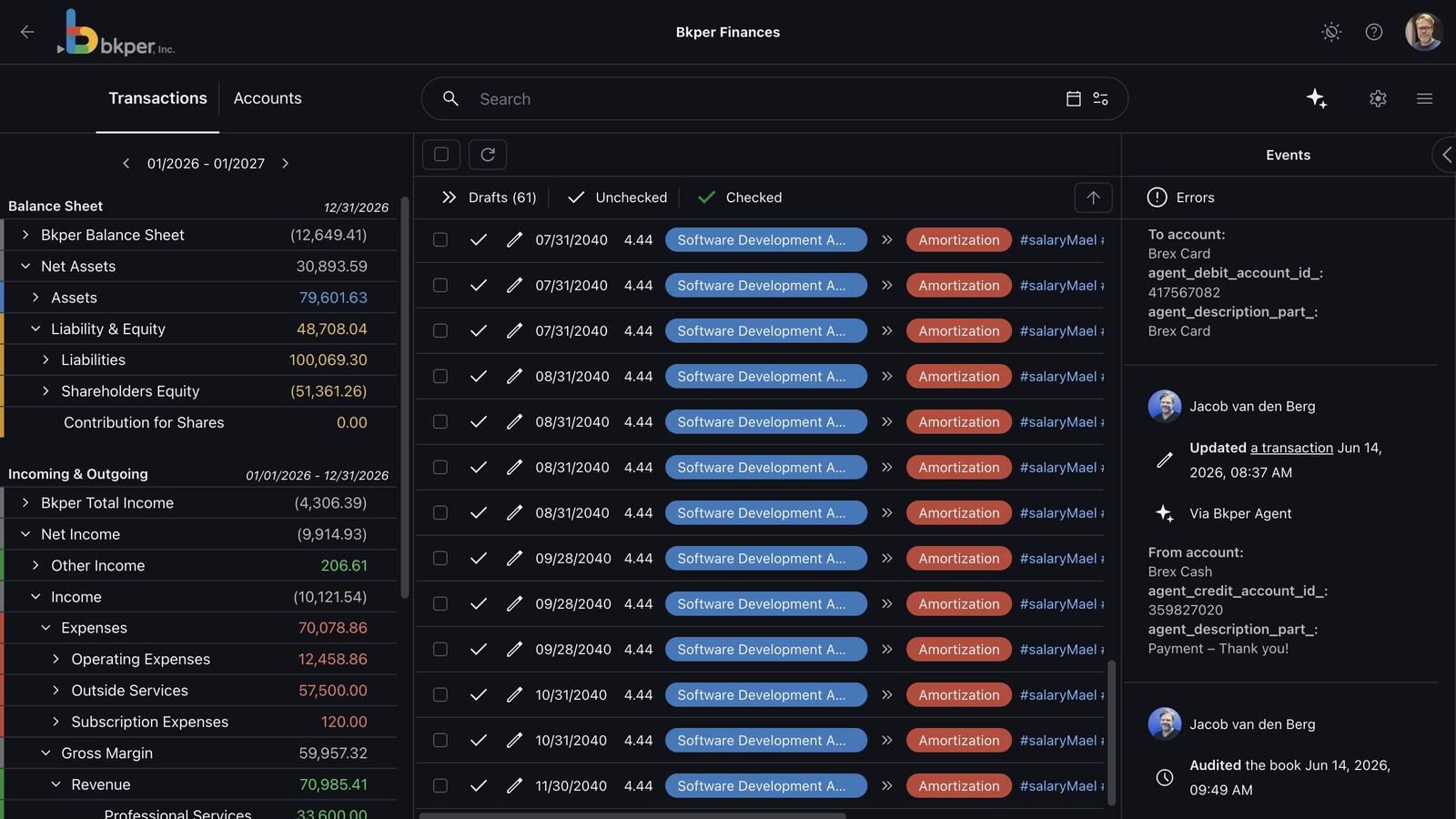
Reading an Event
Each Event tells a small part of the Book history.
Look for these parts:
| Event part | What it tells you |
|---|---|
| Actor | The user, bot, app, bank connection, or AI agent that performed the action |
| Object | The transaction, Account, Group, file, or other record affected |
| Action | What changed, such as created, updated, posted, checked, trashed, or attached |
| Time | When the action happened |
| Response | What an automation did after reacting to the Event, when applicable |
Filtering Events
Select a transaction or relevant record to focus the Activities panel on that object’s history.
For a transaction, the filtered history can show:
- when it was created
- who posted it
- whether it was edited
- when files were added
- whether a bot or app changed it
- who checked it
- whether it was trashed or restored
This is useful for audit work because you can reconstruct the lifecycle of one record without scanning the full Book history.
Humans and agents
Bkper treats human users and automated agents as accountable actors. Both create Events, and both are identified in the Activities panel.
Examples of automated actors include:
- bank connections posting statement transactions
- bots calculating taxes, exchange rates, inventory, or subledger entries
- apps reacting to Book changes
- AI agents extracting transaction data from documents
This makes automation visible. If a bot posts a related transaction or an AI agent extracts data from a file, the action is part of the same audit trail as human work.
Automation responses
When an app or bot reacts to an Event, Bkper records the response on the triggering Event.
A response can explain:
- what the automation calculated
- which transaction or record it created
- what data it used
- whether the action succeeded
- whether an error occurred
Use responses when you need to understand why an automation acted or why it failed.
Troubleshooting automations
Use Events as the first place to investigate automation behavior.
| Need | Where to go |
|---|---|
| Inspect what an app or bot did | Open the related Event in the Activities panel |
| Review an automation error | Open the Event response and read the error details |
| Replay a failed response when available | Use the action exposed on the Event response |
| Install, reconnect, disconnect, or remove an automation | Use the Automations Portal |
| Understand what an app or bot is for | Read the Apps & Bots guide |
Related guides:
How Events power Bkper
Bkper automations are event-driven. Instead of running only on a schedule, they can react when something changes.
Examples:
- A posted transaction can trigger tax calculation.
- A checked transaction can trigger currency conversion.
- A document upload can trigger AI extraction.
- A bank import can trigger matching or categorization.
- A bot-created transaction can generate another Event that a second automation reacts to.
This model makes automation composable while preserving traceability. Each step creates an Event, so the Book remains auditable even when multiple systems act together.
For custom automation development, see: